BUILT FOR UNDERGROUND MINING OPERATORS
Underground Mining Simulation. For Operational Teams.
idoba.sim brings agent-based simulation to underground hard rock mining. Run your weekly schedule through 25 statistically varied simulations to test how it holds up. See where congestion, queuing, and sequence clashes are most likely to surface in simulation, not underground.
Winner, 2025 Mining Technology Excellence Award.

Mine Planning Runs on Assumptions. Not All of Them Hold.
THE PROBLEM
Rate-based planning tools calculate an expected outcome from fixed averages. They assume your trucks run to schedule, queue at fixed locations, and congestion doesn't exist. Every shift underground tells a different story.
The Schedule Looks Achievable on Paper.
Rate-based tools assume trucks run to schedule and congestion doesn't exist, so by Wednesday crews underground are already working to a revised schedule.
One Average Number, or a Realistic Range.
A rate-based schedule gives you a single expected outcome; idoba.sim runs 25 varied simulations so you see the P10/P50/P90 spread.
Capital Decisions Made on Rates, Not Reality.
Fleet sizing, passing bays, and stockpile placement each locks in performance before a metre is developed, and most sites find out what was wrong after capital is committed.
PLANS FAIL IN EXECUTION, NOT ON PAPER
The Plan Only Works if the People Accountable Believe in it.
Every planning decision made underground is owned by someone. The General Manager who signs off the three-month plan. The Technical Services Manager whose recommendations have to hold under scrutiny. The Planning Engineer who has to rebuild the schedule by Wednesday when a heading goes down. idoba.sim gives everyone a quantified basis for confident decisions. No simulation experience required.
YOUR PLANNING TOOLS CAN’T TELL YOU IF IT WILL HOLD
Back Recommendations with Data, Not Experience Alone.
idoba.sim gives Technical Services Managers the quantified basis to refine planning assumptions and identify where the risk sits in the schedule, before the shift starts.
Run your weekly schedule through 25 statistically varied simulations and surface a P10, P50, and P90 probability distribution across your mine network. Replace gut-feel with a number you can take into any room and collaborate on.

EXPERIENCE-BASED ESTIMATES ALONE WON’T CUT IT
Capital Decisions Backed by Simulation Data.
You're accountable for production outcomes, capital allocation, and the credibility of the numbers you take to the leadership team. When your planners tell you a new fleet configuration will close the gap, or that a second loader will move the needle, idoba.sim is how they test it before you commit the capital.
idoba.sim gives General Managers a quantified distribution of what each plan can realistically deliver across your mine network. P10, P50, and P90 outcomes sit behind every major planning decision. A range your team can work with.

STOP THE MID-WEEK SCRAMBLE
Build a Schedule the Crew Can Execute.
The weekly schedule came out of your scheduling tool looking clean, but by Wednesday you're across three email threads trying to explain why the advance rate isn't there and the Shift Supervisor has stopped trusting the sequence. idoba.sim lets you stress-test the schedule before it goes underground, not after the wheels fall off.
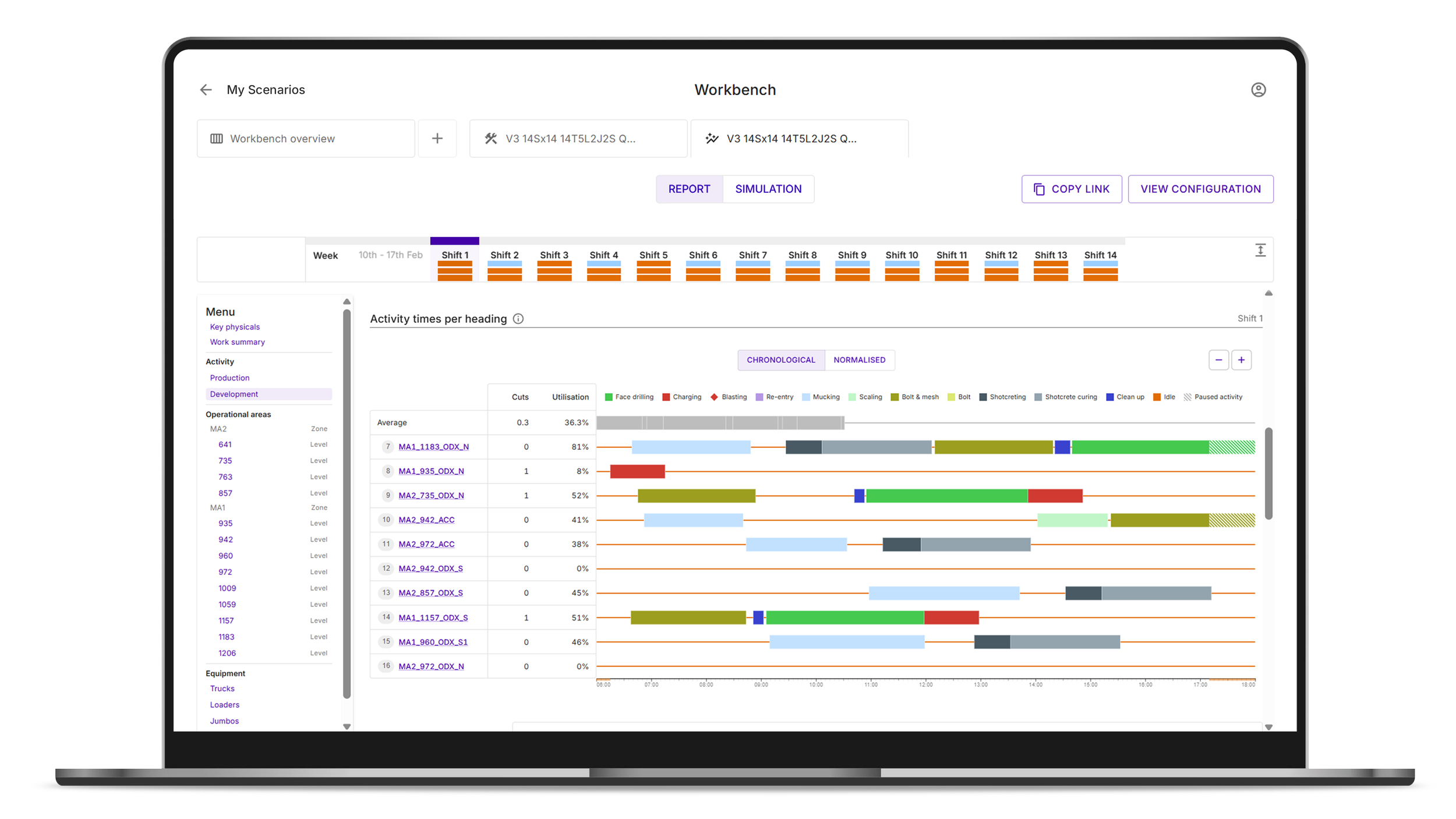
Run the week ahead through idoba.sim. Surface the congestion points, the jumbo conflicts, and the truck queues before the crews are committed. Arrive at sign-off with a schedule that operations can see holds up, against real interaction data.
SIMULATION CASE STUDIES
Proof from Real Underground Operations.
Every metric below comes from a formal case study in real underground mining operations. No synthetic benchmarks. No theoretical projections.
OPTIMISING MINE DESIGN
How Stockpile Placement Changes Every Tonne Underground.
Adding a dedicated stockpile changes how every truck, loader, and shift sequence interacts underground. The question isn't whether a stockpile helps in theory. It is whether it helps enough in your mine, and whether the capital is justified before you commit.
A recent study used idoba.sim to model dedicated stockpile placement in an underground hard rock operation. The simulation examined total material moved, ore tonnes delivered to surface, truck productivity, and shift transition performance across the P10, P50, and P90 range. The planning team had the simulated data to make the capital case before a single tonne of ore was moved.
12%
Increased Ore to Surface.
10%
Reduced Truck Cycle Time.
39%
Increased Loader Utilisation.
12%
Increase in TKM per Shift.
FLEET AND EQUIPMENT SIZE
Right-size Your Fleet Before You Commit the Capital.
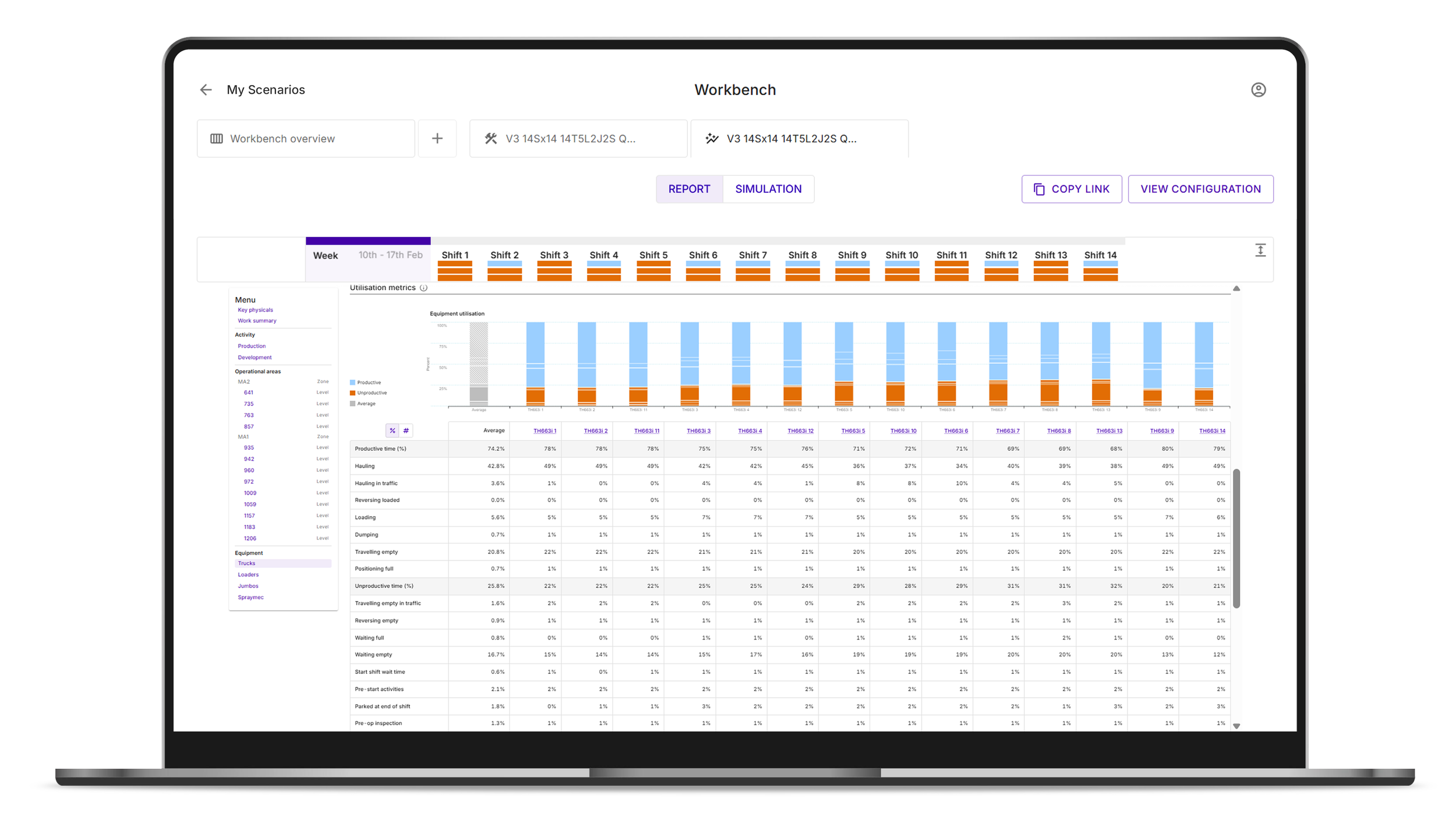
Fleet sizing decisions in underground mining are rarely tested before the commitment is made. Adding a truck seems logical. But underground, congestion often costs more than the extra capacity gains. Rate-based scheduling tools can't show you that before the machine is on site.
This simulation study shows how idoba.sim can be used to evaluate truck, loader, and production front interactions underground and how agent-based simulation can surface the queuing patterns, idle time, and throughput constraints that fixed-rate calculations often miss.
31%
Increased Ore to
Surface.
26%
Improved Truck
Productivity.
“With idoba.sim, I could quickly and easily stress-test schedules against real-world data to make sure operations underground are cost-effective and the targets are achievable.”
— Matt Elston, Operations Specialist at Barminco Australia
REDUCING VEHICLE INTERACTION
Fewer Near-misses Start with Agent-based Simulation.
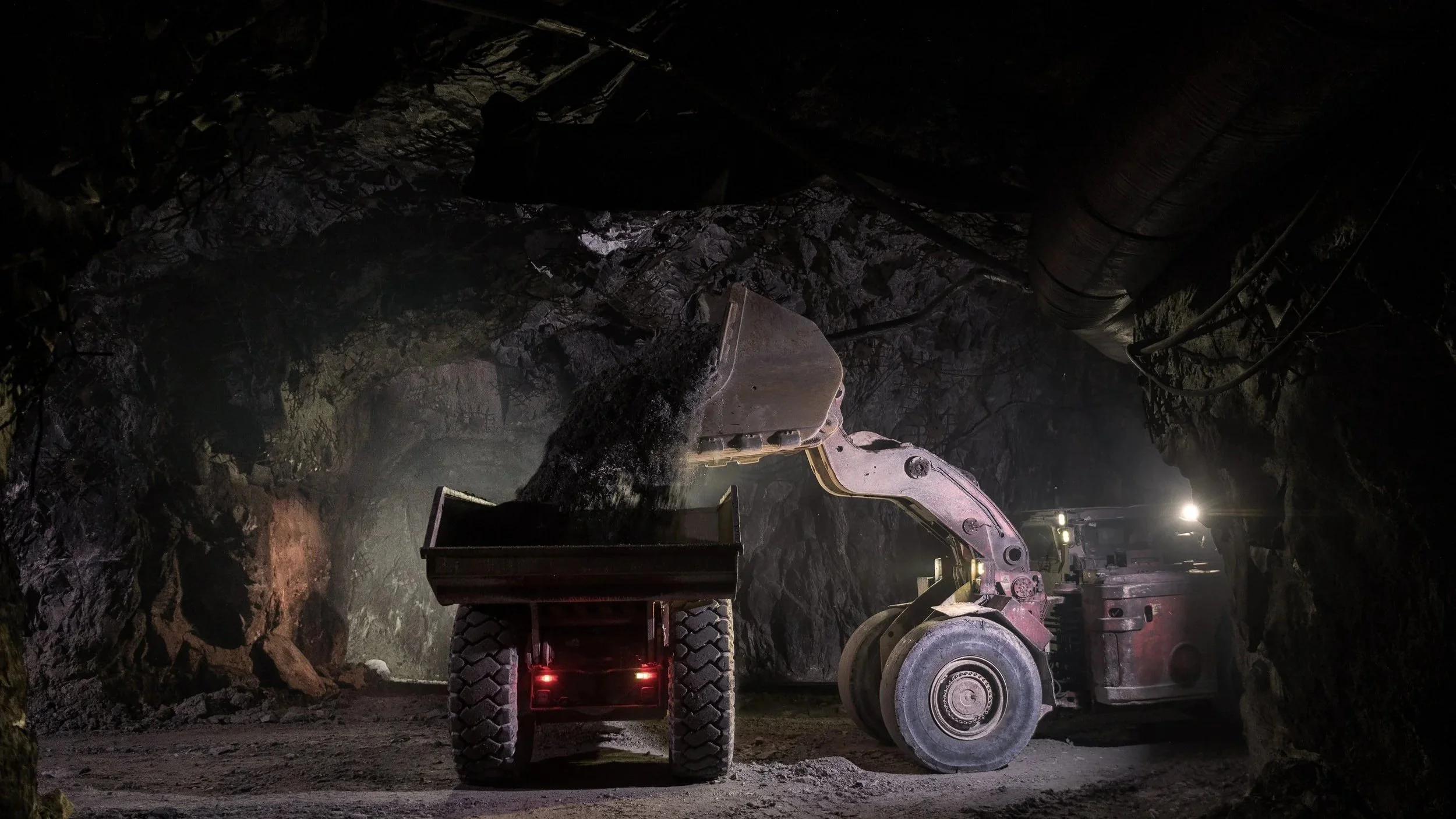
In underground hard rock mining, vehicle proximity events don't happen randomly. They happen where mine design, traffic rules, and schedule density create conditions for interaction. By the time the near-miss is recorded, the root cause has been built into the operation for months.
An Australian gold mine used idoba.sim to model congestion risks across a complex underground haulage network. The simulation evaluated how mine design decisions, traffic sequencing rules, and shift configuration affected vehicle interaction frequency before any operational change was made. The findings gave the planning team a basis for redesigning traffic rules, work sequencing and crew composition.
10%
Identified Reduction in Vehicle Interactions Without Impacting Material Movement.
SOLUTION CAPABILITIES
From Weekly Scheduling to Capital Decisions. idoba.sim Handles Both.
STRESS-TEST WEEKLY SCHEDULE
Stress-test Your Weekly Schedule Before Execution.
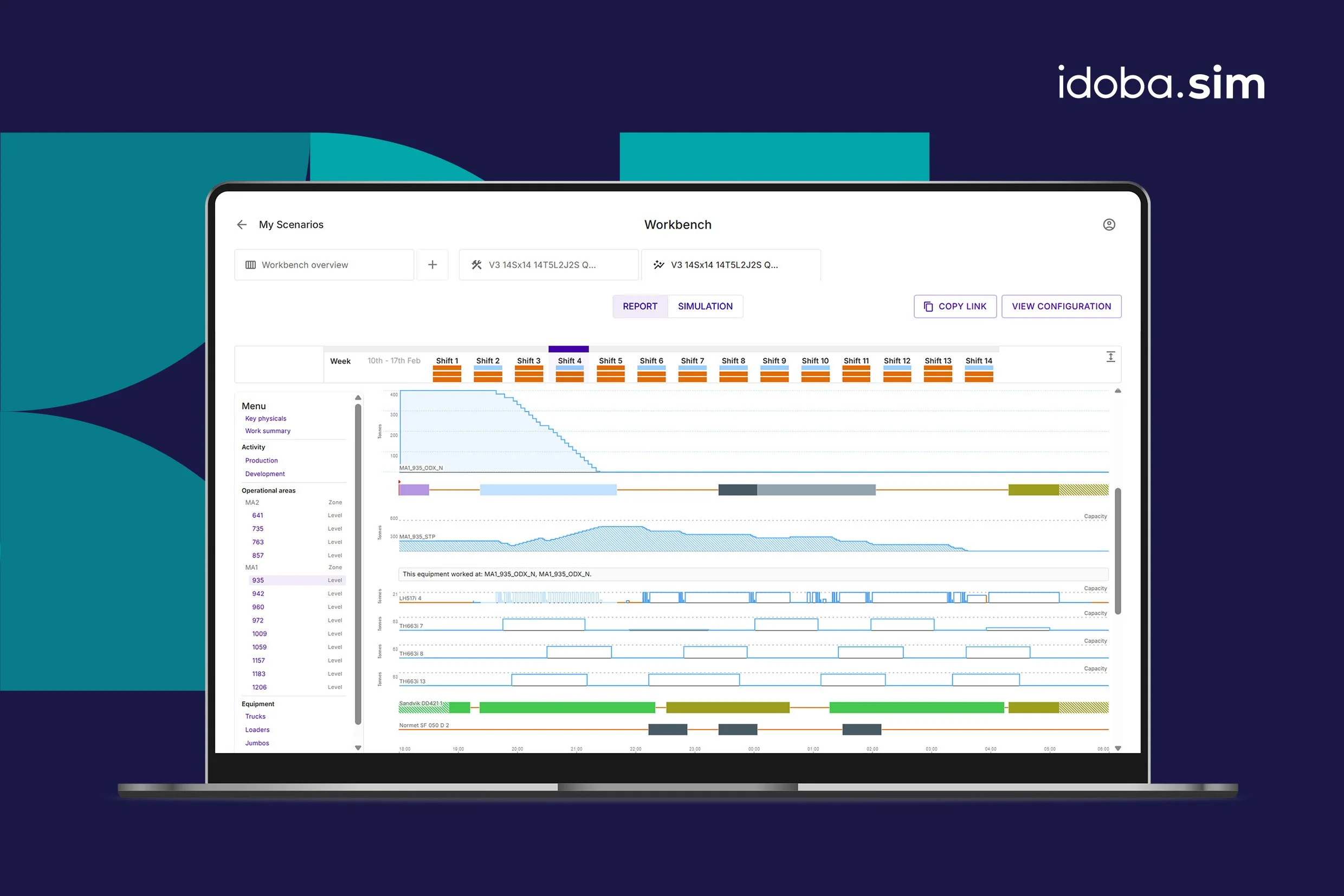
idoba.sim runs 14-shifts ahead so you can test the schedule before crews are committed. Congestion bottlenecks, sequence clashes, and truck-loader misalignment surface in simulation, not underground.
Know where the schedule is at risk and what to change before the shift starts.
Surface congestion bottlenecks and sequence clashes before crews are committed.
Compare scenarios across the P10/P50/P90 range to see which schedule holds up before you commit to it.
Give planners a quantified basis to take into shift planning meetings, complementing existing experience, and work processes.
DEVELOPMENT ADVANCE SIMULATION
Model the Full Development Cycle Before Committing Resources.
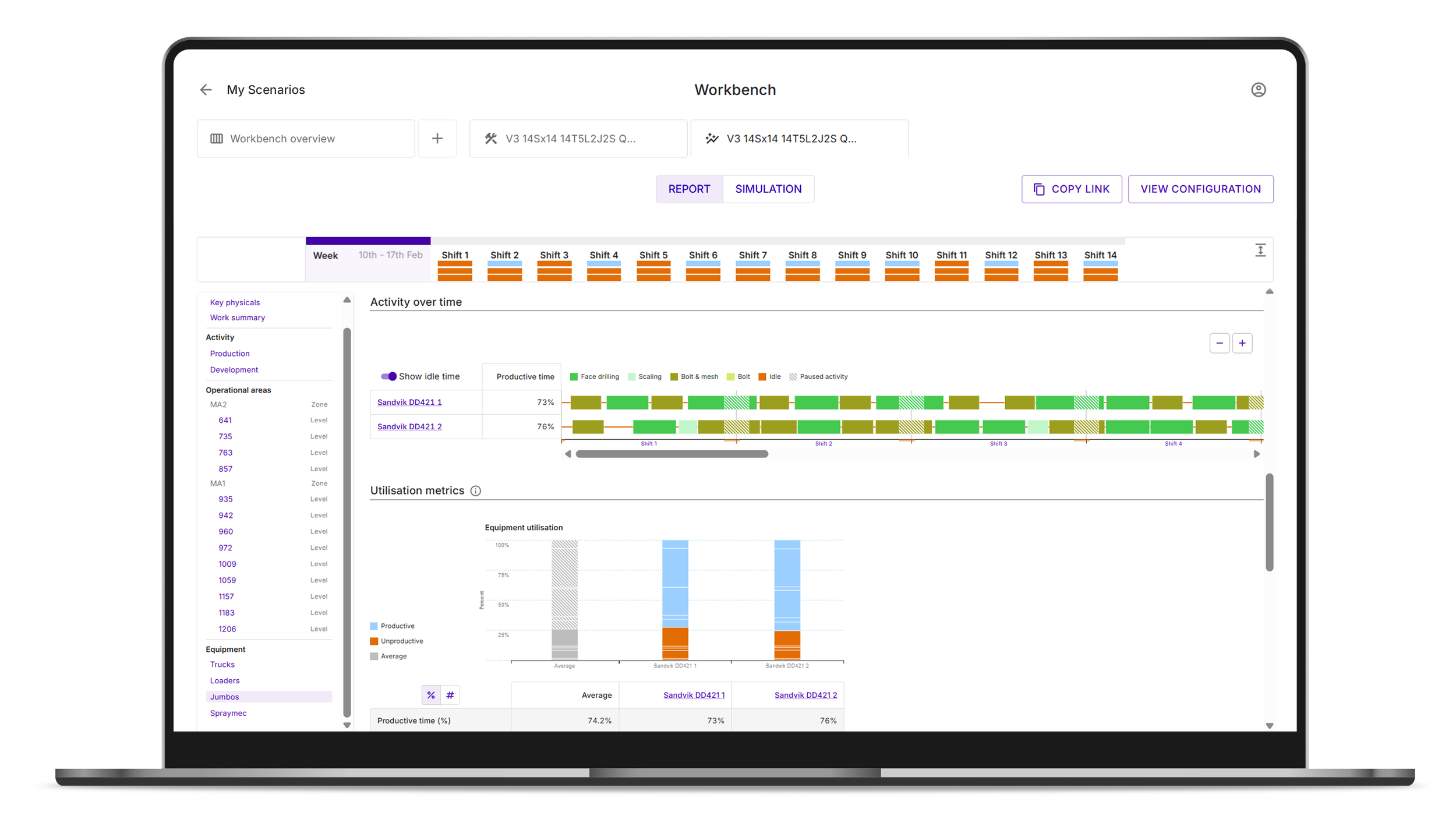
Development advance performance is determined by how jumbos, spraymecs, trucks, and loaders interact across the full cycle: mucking, scaling, bolting, charging, re-entry. Rate-based tools model the average. idoba.sim models the interaction.
Test the schedule before it locks in shift commitments and advance metre targets.
Identify jumbo conflicts and constraints before they cost advance metres.
Validate metre targets against real cycle time distributions, not theoretical averages.
Justify additional jumbo or resources with simulation data.
LOAD-AND-HAUL OPTIMISATION
Find the Bottlenecks Before the Shift Starts.
Fleet sizing is often estimated on broad assumptions. idoba.sim reveals where the congestion sits and what the optimal fleet configuration looks like before a single tonne is moved underground.
Surface the inefficiencies before it costs you ore tonnes.
Test fleet size and truck-to-loader ratios without committing capital.
Identify queue formation and idle time before shift handover.
Make fleet investment decisions with simulation evidence, not experience alone.
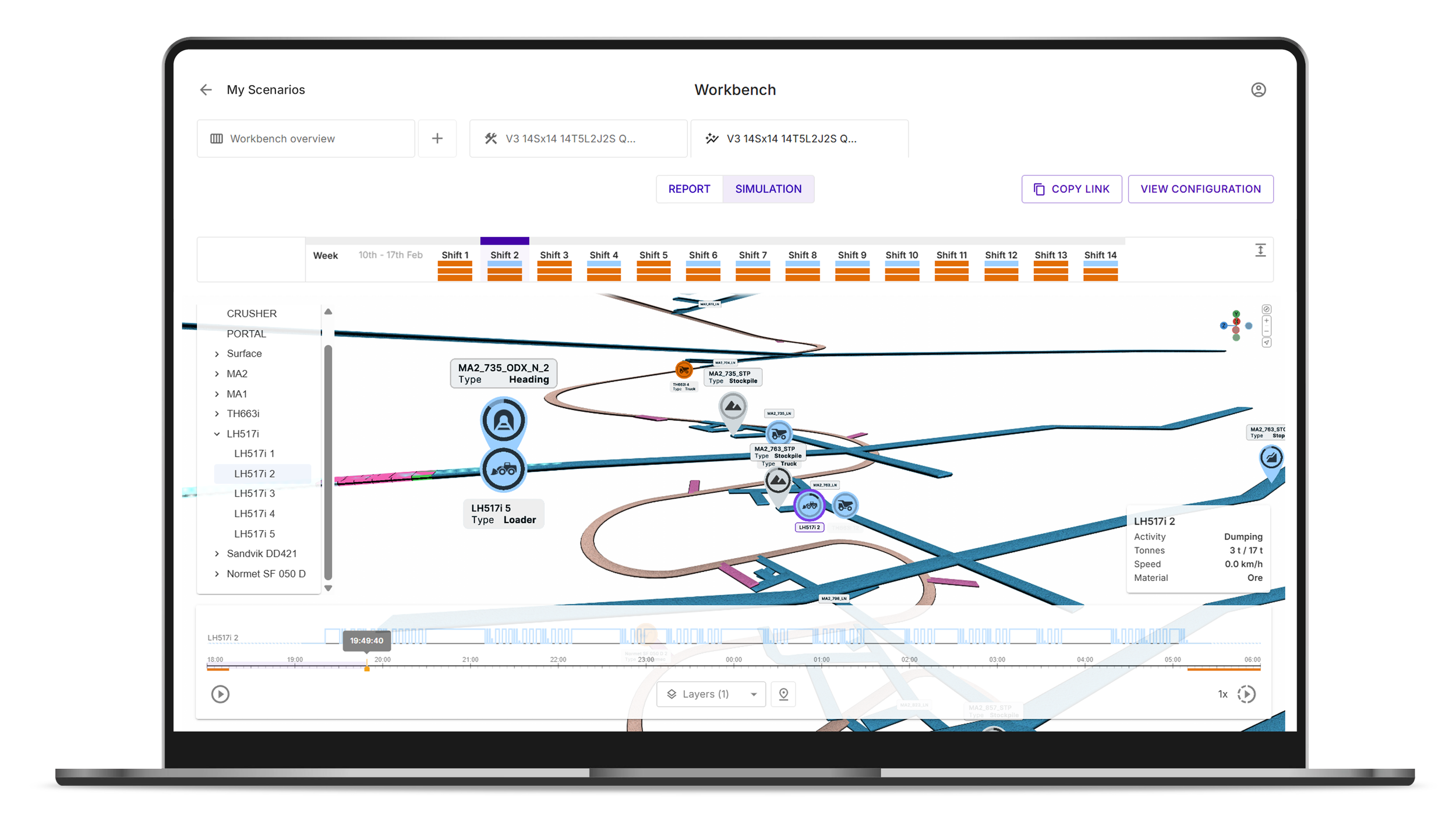
Agent-based Modelling. Not Fixed-rate Averages.
WHY IS IDOBA.SIM DIFFERENT
Conventional planning tools use fixed rates. idoba.sim runs differently. Every truck, loader, and jumbo operates as an independent agent with its own logic, constraints, and priorities. Loaders wait when the face isn't ready. Trucks queue when the decline is congested. Shift change effects ripple through the network the way they do underground.
Run 25 statistically varied simulations per scenario. The output is a P10/P50/P90 distribution, the realistic range of what your schedule can deliver. Not an average. A range your team can work with.
HOW IT WORKS
Three Steps to Short-term Planning Confidence.
idoba.sim is built for operational mining teams, not simulation specialists. No expert hire. No complex setup. Your mine planners run the simulation, and the results feed directly into your short-term planning and capital decisions.
NO SIMULATION EXPERIENCE REQUIRED
Your Fleet. Configured in Minutes.
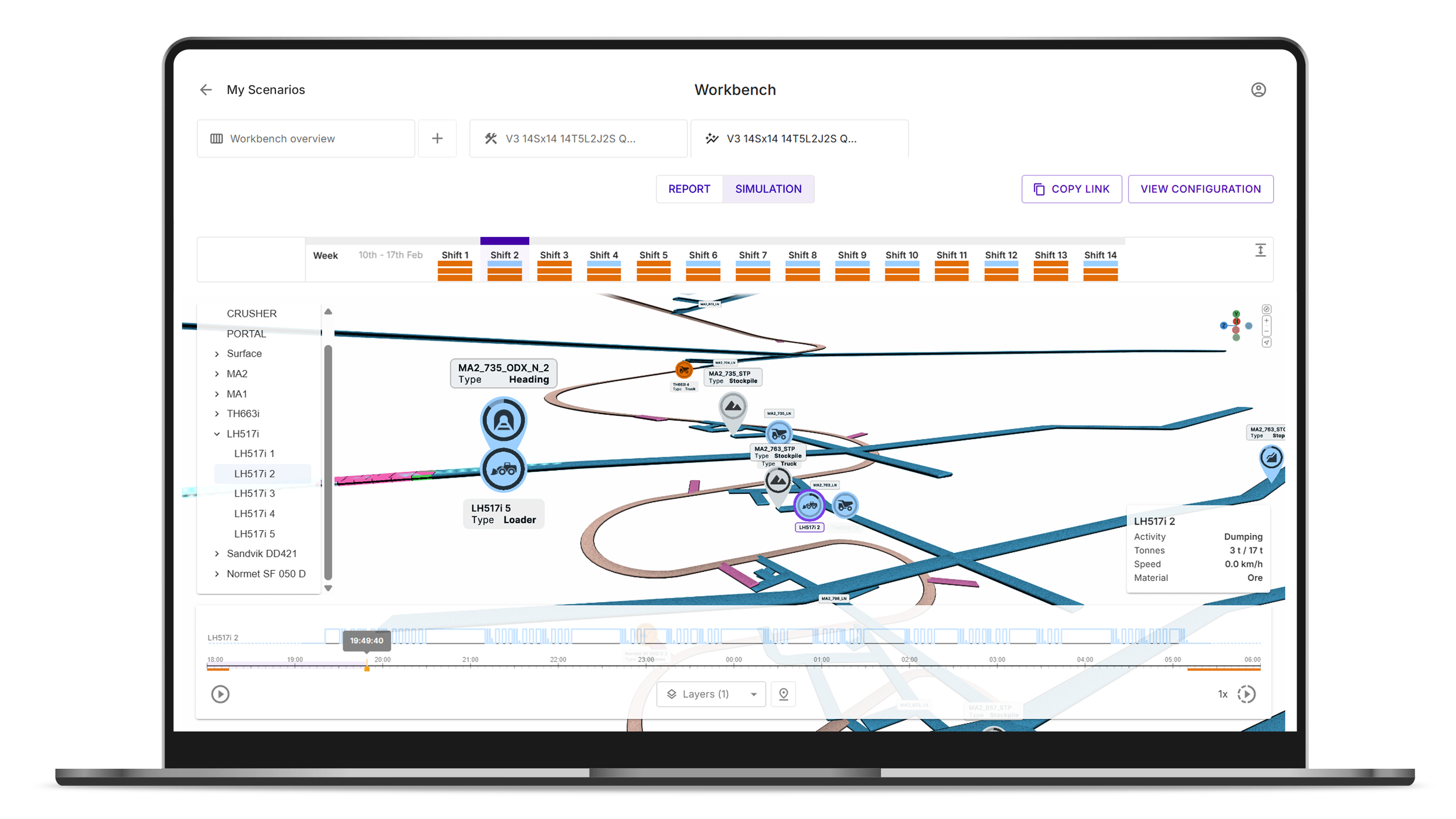
Most simulation tools require specialist setup before you can run a single scenario. idoba.sim starts with what your team already knows: your equipment. Select your jumbos, loaders, trucks, and spraymecs from a library of assets and replicate your existing fleet in minutes.
BUILT AROUND YOUR MINE NETWORK
Map Your Tasks to Locations. Run the Sim.
Define the work your equipment needs to do using your underground locations: stopes, headings, stockpiles, and surface destinations. idoba.sim builds the simulation around your mine network, not a generic template.
FROM SIMULATION TO DATA BACKED DECISIONS
Run the Scenarios. See What Changes.
Run 25 statistically varied simulations and see results across the varied outcomes. Equipment utilisation, cycle times, ore tonnes, loader idle time. Every KPI your team reports on, surfaced in a single view. Take the output straight into a planning meeting or a conversation with the leadership team.
Like to Stress-test Next Week’s Schedule Before It Goes Underground?
idoba.sim is built for underground mining teams who need to validate schedules before crews are committed, identify bottlenecks before they cost advance metres, and make fleet and sequencing decisions based on simulated results, rather than fixed averages.
Frequently Asked Questions.
-
idoba.sim is cloud-based, so once your mine network is configured, scenarios can be set up and running in minutes. Initial network configuration is supported by our dedicated product specialists who will work alongside your team. No simulation expertise is required.
-
Automated reports cover the metrics Planning teams need to validate the weekly schedules: development rates, truck cycle times, tonne-kilometres, loader utilisation, primary tonnes moved, and equipment idle time. Results are returned as a P10/P50/P90 distribution across 25 statistically varied runs, so you see a realistic range, rather than fixed-rates.
-
idoba.sim employs various modelling techniques, including agent-based modelling, to accurately simulate individual entities like jumbos, trucks, and loaders. This provides you with useful insights and potential operational outcomes.
-
Agent-based modelling, or ABM, is a simulation technique where each piece of equipment is represented as an independent agent with its own behaviour, constraints, and interactions. Rather than calculating a single average outcome from rate-based inputs, ABM lets each truck, loader, jumbo and spraymec operate against the mine network and respond to what the other agents are doing, queues forming at intersections, loaders working to a defined priority sequence, trucks tramming back through congestion. idoba.sim runs the same scenario 25 times with statistical variation to produce a distribution of outcomes rather than a fixed rate, which is closer to how the operation actually behaves. ABM is distinct from AI or machine learning, it's a well-established simulation method, applied here to the specific dynamics of underground mining.
-
Yes. A dedicated product specialist runs coaching sessions with your team to configure your mine network, set up your initial scenarios, and interpret the results. idoba.sim is built for operational mining teams rather than simulation specialists, so the focus is on getting your Planners productive quickly.
The Underground Mining Problems Worth Exploring Before You Plan Your Next Shift.
WANT TO GO DEEPER