

INDUSTRIAL AI FOR ALUMINIUM SMELTERS
Identify Cathode and Sidewall Failure Risks Earlier.
idoba.predict is a digital twin for aluminium smelters that uses machine-learning models developed for specific cathode and sidewall failure modes. It analyses a smelter’s operational and laboratory data in near real time for each pot to surface developing risk earlier, giving engineers more time to intervene before damage progresses.

Damage Develops Before Failure Becomes Obvious.
THE COST OF FINDING OUT TOO LATE
Cathode and sidewall damage can develop before the condition becomes obvious, or before any single reading or fixed limit makes the emerging pattern clear. Once the problem becomes known, the response window may already be narrowing: fewer options to investigate, less time to plan, and a greater risk of further damage or production disruption.
INSIGHTS EARLY ENOUGH TO CHANGE THE OUTCOME
Bring Developing Risk to Attention While Options Remain.
idoba.predict surfaces earlier indications of cathode and sidewall damage events for individual pots. Engineers can prioritise investigation, test the signal against operating context and determine the appropriate response before damage progresses.
DIGITAL TWIN + MACHINE LEARNING
Intelligence Built Around The Failure Mechanism.
A pot-level digital twin brings relevant operational and laboratory conditions together for each pot in near real time. Dedicated machine-learning models assess the complex relationships associated with cathode and sidewall failure modes. The result is not simply an indication that something has changed: it is failure-mode specific risk attributed to an individual pot and surfaced with context for engineering review.
Together, these technologies extend failure-mode specific predictive attention consistently across the deployed potline without replacing engineering investigation, judgement, or action.
Each Pot Represented in the Digital Twin.
Bring approved operational and laboratory conditions together in a data-informed representation of each pot over time.
Failure Mode Specific Machine Learning.
Apply models developed for cathode and sidewall failure modes rather than reducing the output to a generic anomaly score.
Predictive Analytics Across The Potline.
Assess complex relationships consistently across the deployed scope and direct limited engineering attention to priority pots.
Designed For Engineering Judgement.
At-risk pot identification, failure-mode insight and approved operating context, so engineers apply a data-directed response.
FROM DATA TO DECISION SUPPORT
From a Smelter’s Data to an Owned Engineering Response.
idoba.predict operationalises predictive models through a product designed for day-to-day engineering use. It connects site data, a pot-level digital twin, failure-mode specific machine learning and the supported engineering workflow in one decision path.
PRODUCT CAPABILITIES
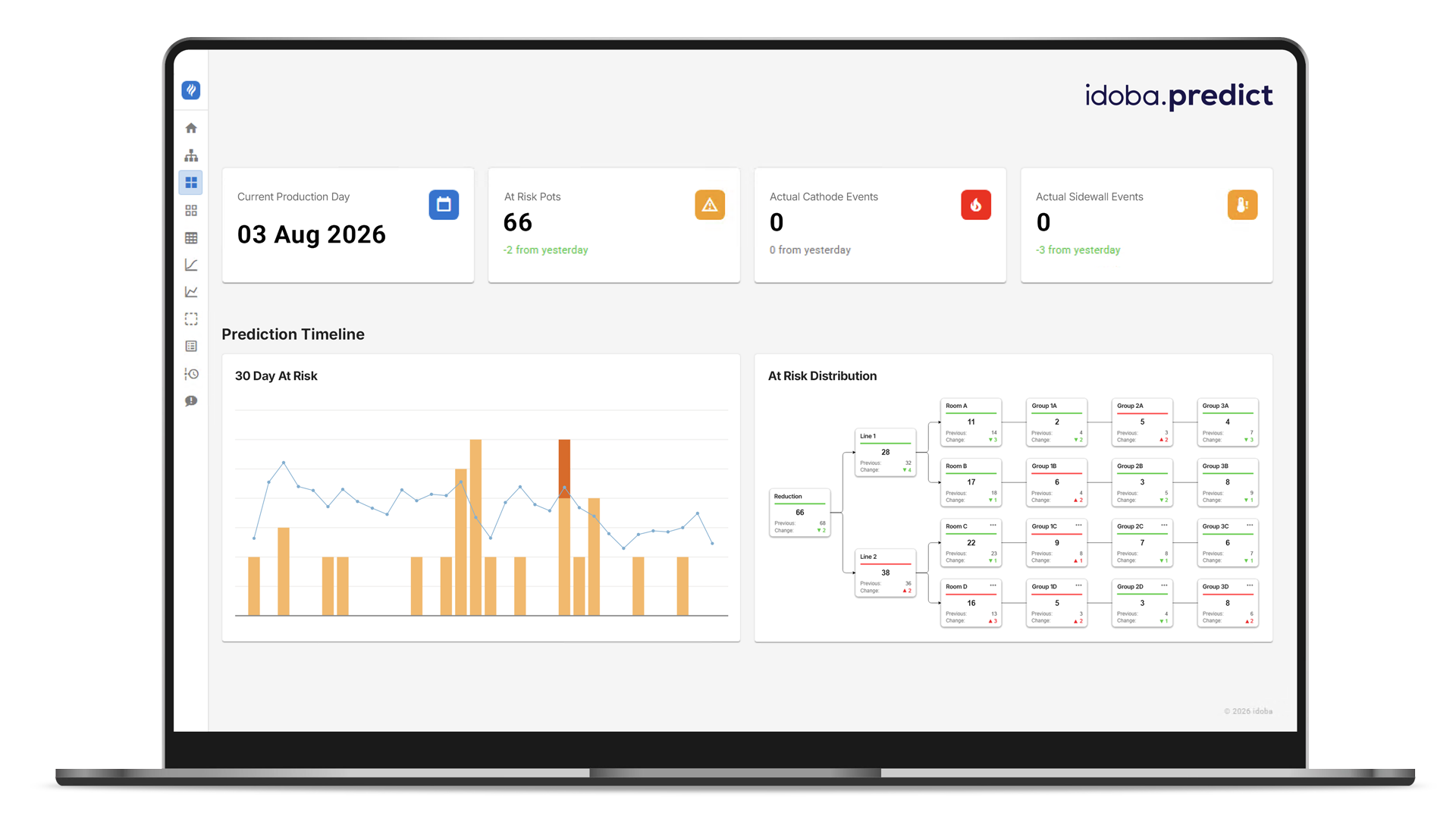
idoba.predict turns failure-mode specific predictions into a working engineering view. Teams can see where attention is required, move from the smelter view to the individual pot, examine the conditions contributing to risk, review how the risk developed and retain the response.
See Risks Across The Potline. Investigate it Pot by Pot.
POTLINE ATTENTION
See Risks Across the Entire Potline.
View developing cathode and sidewall risk in the operating layout, so the team can see where engineering attention is required.
SMELTER TO POT DETAIL
Move From Smelter Trend to Pot Detail.
Move through the approved operating hierarchy to see where risk is concentrated, then continue to the named pot that requires investigation.
PRIORITISED POTS
Prioritise Pots And See What is Contributing.
Rank and filter surfaced pots by current failure-mode specific risk, with approved operating and laboratory context available alongside the prediction.
RISK HISTORY
Investigate How Risk is Developing.
Review the pot’s prediction history, known events and selected process parameters on a shared timeline to test the signal against the operating context.
OWNED RESPONSE
Turn Prediction Into an Owned Response.
Acknowledge surfaced risk, record supported investigation or action and retain visible status and history for follow up while engineers remain responsible for the decision.
OPERATIONAL VALUE
Earlier Failure Insight Creates a Wider Response Window.
By bringing developing risk to attention earlier, idoba.predict gives teams more time to determine the appropriate response and coordinate intervention. That time advantage is the mechanism through which the product can support longer pot life, protect stable metal production, and reduce the cost and safety exposure of unplanned failure.
Support Pot Life and Production.
Bring developing risk to attention while there is still time to investigate, intervene and limit damage progression.
Reduce Unplanned Failure Exposure.
Create more time for a controlled response and reduce the cost and safety exposure associated with urgent intervention.
Built For The Teams Responsible For Potline Performance.
Smelter and Operations Leadership.
Protect metal production and reliability through earlier visibility of pot failure risk, then scale after value is validated.
Technical and Process Leadership.
Evaluate failure-mode logic and whether the evidence supports engineering judgement on the smelter's pots.
Electrolysis and Potroom Operations.
Create more time to prioritise and act on the individual pot data.
Data, Digital, and IT/OT Teams.
Assess data integration, cadence, model controls and the path from pilot to governed operational use.
THE EXPERIENCE OF OPERATORS, ENCODED IN SOFTWARE
Aluminium Expertise Shapes What the Product Predicts and How Teams Act on it.
Aluminium specialists shape the failure modes modelled, validate the operating relationships assessed, the outputs surfaced and how prediction moves into engineering action.idoba.predict extends that failure-mode specific attention consistently across the potline while engineers retain responsibility for investigation, judgement, and action.
Failure Modes Grounded in Aluminium Reduction.
Cathode and sidewall models are developed around specific damage mechanisms and the operating context in which they emerge.
Operating Relationships Selected for Relevance.
Aluminium and data-science specialists determine which approved operational and laboratory relationships the models assess, and which context engineers need to interpret the output.
Prediction Designed to Move Into Use.
Outputs and workflow are shaped around how engineering teams prioritise, investigate, acknowledge and respond, not around presenting a model score in isolation.
See How Earlier Failure Insights Could Fit Your Operation.
Discuss how idoba.predict could be evaluated against your smelter's data, priority failure modes and engineering workflow, with engineers retaining judgement and control.
Frequently Asked Questions.
-
It analyses the relevant operational and laboratory data already collected by the smelter. Exact inputs, history, quality requirements and cadence are confirmed for each deployment.
-
Alarms indicate when a defined condition crosses a set limit. idoba.predict uses machine-learning models developed for cathode and sidewall failure modes to assess complex relationships across pot-level operating and laboratory data in near real time, and bring developing risk to attention earlier.
-
At-risk pots and failure-mode-specific insight, with a prioritised list of the parameters of concern, to help the team prioritise investigation and determine the appropriate response.
-
It is a data-informed representation that brings actual and predicted operational and laboratory conditions together for each pot over time. The exact inputs, history, connections, update cadence and deployment scope are confirmed with the smelter.
-
No. idoba.predict is predictive decision support. The outputs inform engineers, who make the data-based decisions and take corrective action.
-
A deployment can range from near real time to a frequency that better suits an operating site’s data. The exact cadence is defined around the site’s data and deployment scope and confirmed during implementation.
-
A pilot begins with a review of the smelter’s available operational and laboratory data, priority failure modes, objectives and existing engineering workflow. The pilot scope, data requirements, implementation process and success measures are then agreed with the smelter team.