

Stress-test Your Schedules. Before Committing Crews.
idoba.sim models every truck, loader, and jumbo as a separate agent against your mine network and shift sequences, so you can see where development, ground support, and load-and-haul interact across the full week (14 shifts) before crews go underground. The output is a distribution of outcomes (P10/P50/P90) range you can put in front of your General Manager with confidence.
Winner, 2025 Mining Technology Excellence Award.

Plan with Confidence.
Recommend Changes with Credibility.
idoba.sim covers the full underground operating cycle for portal-access hard rock mines, from development advance and ground support through to truck load-and-haul, across 14 shifts. Your planning team can model how those activities interact before the schedule goes underground. No simulation experience required.
Test New Mine Layouts and Designs.
New headings, revised access layouts, and expanded production areas all carry assumptions about how equipment will behave in practice. idoba.sim lets you model the design against your fleet and mine network, so you can identify congestion, bottlenecks, and sequencing conflicts before construction begins, not after.
Validate Capital Decisions with Simulated Data.
Fleet purchases, development commitments, and feasibility schedules are routinely built on assumptions. idoba.sim adds an identified range of possible outcomes to refine assumptions and identify where the risk sits in the schedule. A risk profile your planning team can use to make capital decisions with confidence.
Stress-test Schedules Before You Commit.
When production pressure forces a heading change, a fleet re-allocation, or a revised 14-shift schedule, the consequences ripple through equipment interactions that rate-based planning tools often miss. idoba.sim shows you where the bottlenecks are likely to emerge and whether the revised schedule can deliver your targets.
SIMULATION USE CASE
Benefits of a Dedicated Stockpile.
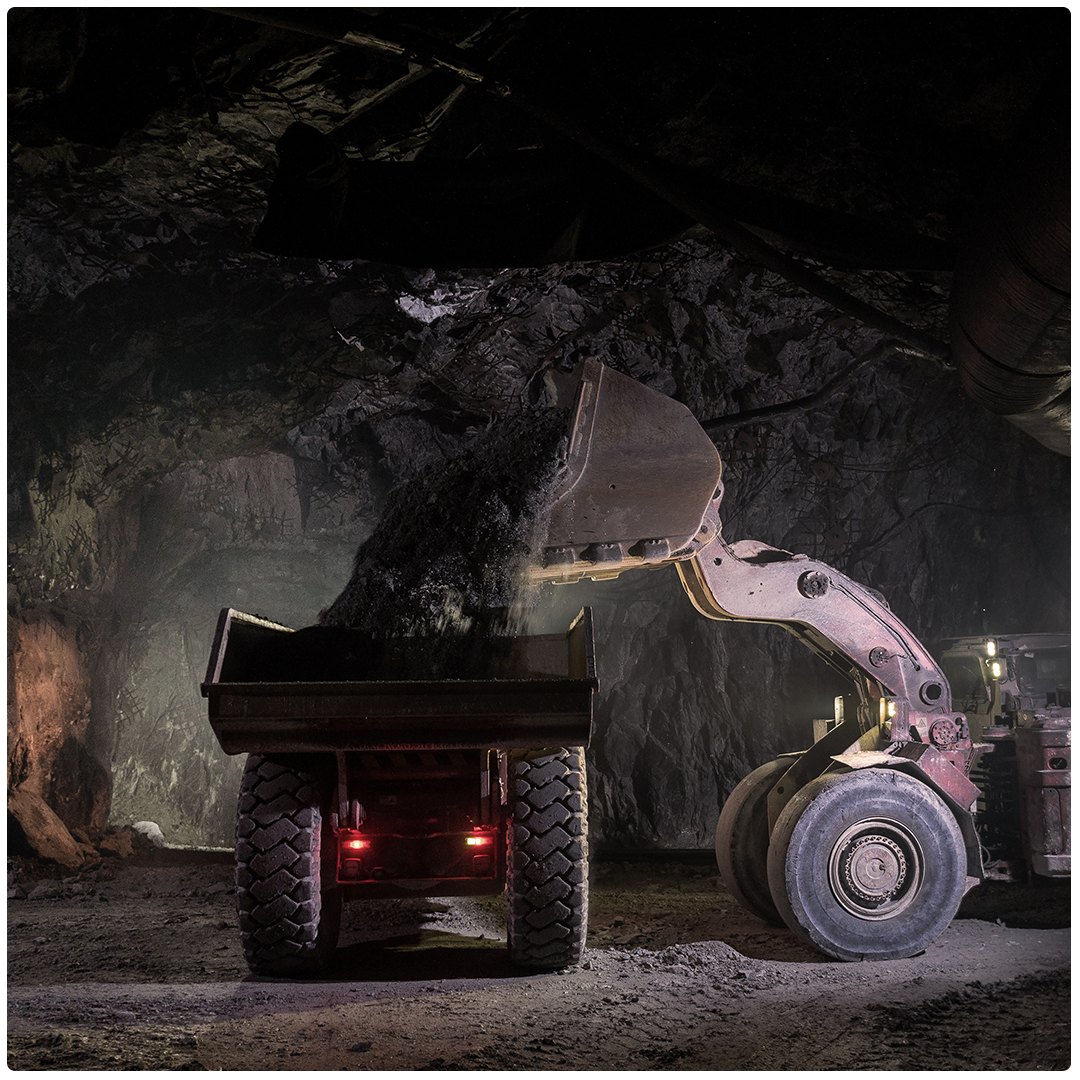
Adding a stockpile changes how every truck, loader, and shift sequence interacts underground. The question isn't whether a stockpile helps in theory. It is whether it helps enough in your mine.
In a recent study, idoba.sim was used to model the impact of a dedicated stockpile in an underground hard rock operation, examining total material moved, ore tonnes delivered to surface, truck productivity, and shift transition performance across the P10/P50/P90 range.
The simulation showed how stockpile placement affects load-and-haul interactions, shift changeover efficiency, and overall ore delivery, giving the planning team the evidence to make the capital case before committing.
12%
Increased Primary Ore Throughput.
39%
Increased Loader Utilisation.
The Schedule was Executable. Until the Third
Shift Started.
idoba.sim runs 25 statistically varied simulations of development, ground support and haulage activities before a single crew goes underground. See where the schedule breaks down, before the shift does.
SCHEDULE VS EXECUTION ANALYSIS
Back Recommendations with Simulated Data.
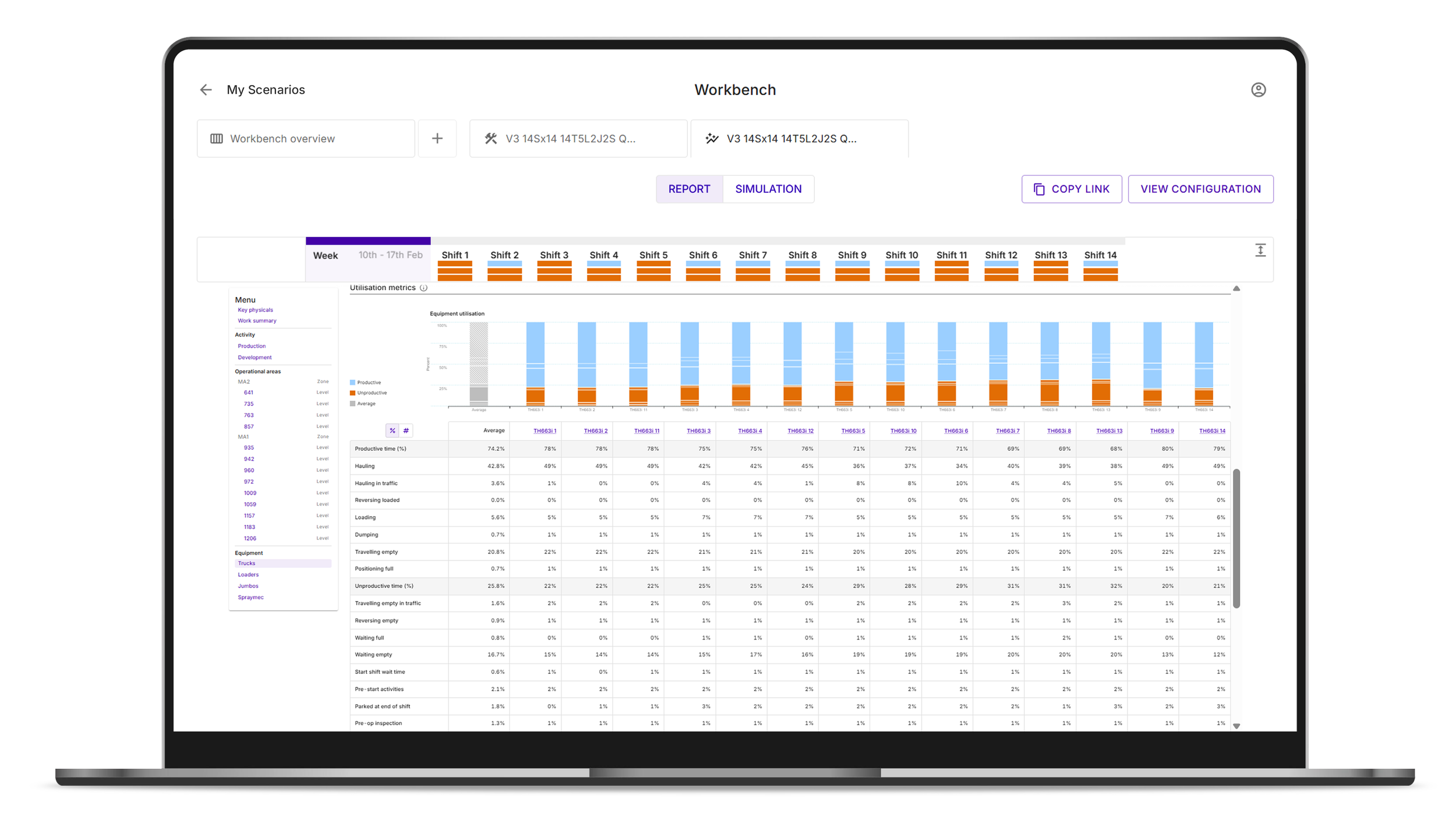
Rate-based tools give you a single number on paper. idoba.sim shows you the full distribution. Run your weekly schedule through 25 statistically varied simulations and see a P10 to P90 probability distribution modelled against your mine network.
See where fleet interactions create the gap between what the schedule promises and what executes underground. Identify where the risk sits in the schedule before crews go underground.
MINE NETWORK VISABILITY
See Where Throughput is Lost Before the Shift Starts.
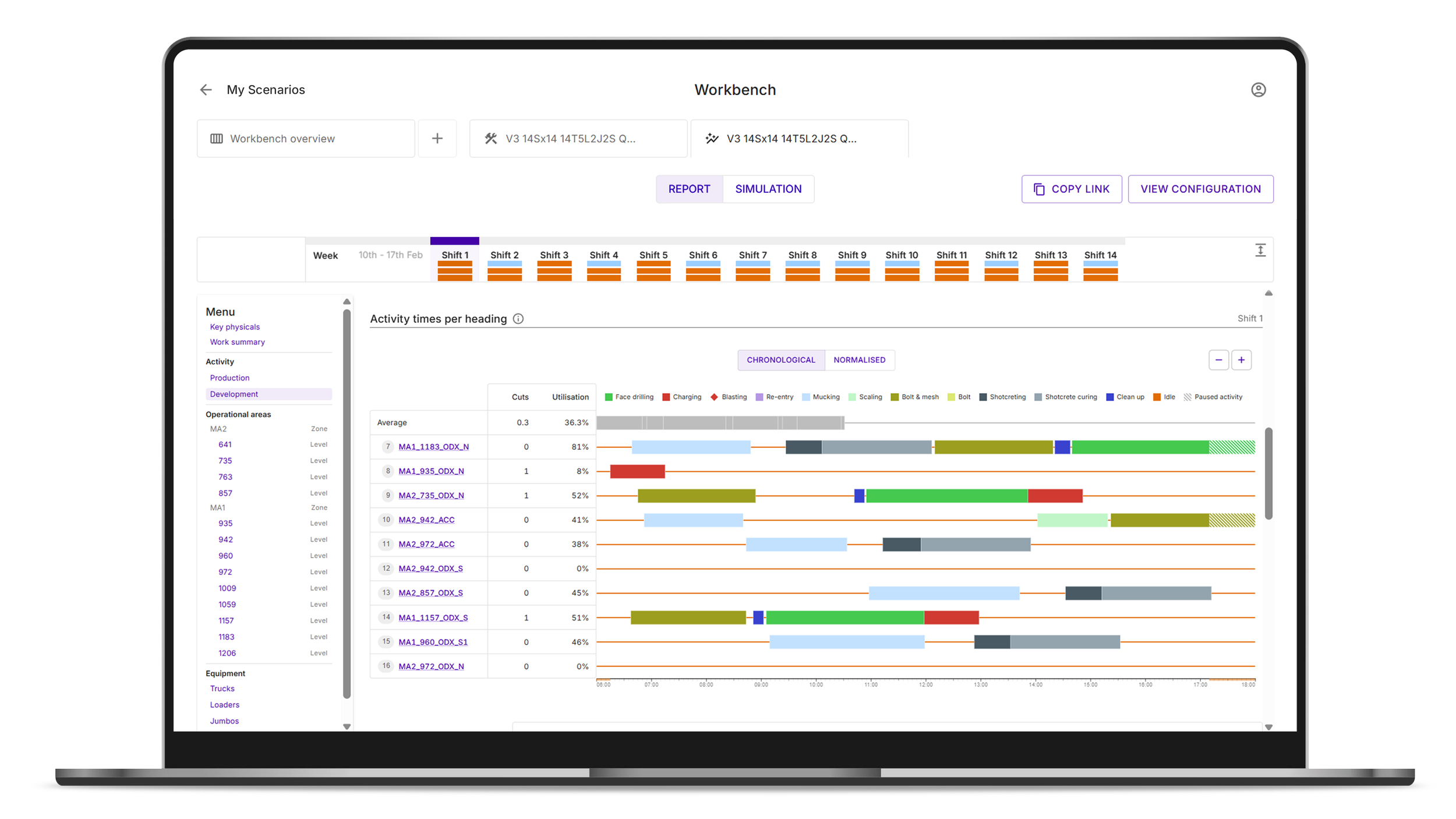
The mine network view shows every truck, loader, and jumbo positioned against your schedule. See where equipment interactions create congestion, where equipment is operating at the same access point, and where throughput is most likely to be lost.
idoba.sim surfaces these bottlenecks before the schedule is locked in. Adjust the sequence, re-run the scenario, and confirm the revised allocation holds across all shifts before crews go underground.

UNPLANNED EVENT RECOVERY
Re-plan. Test the Revised Schedule. Recover on Target.
A ground support delay at one heading. An equipment breakdown that reshuffles the sequence. Conditions underground change constantly, and when they do, the consequences ripple through equipment interactions, infrastructure access, and activity sequencing in ways your existing tools struggle to identify.
idoba.sim lets the planning team re-run the revised schedule against the mine network before it is committed. Test whether the new heading sequence still delivers the weekly target. Confirm the revised fleet allocation holds across remaining shifts. Commit to a schedule you can communicate with confidence.
Simulation Software Built for Underground Mining.
Cloud-based. No Complicated Infrastructure to Manage.
idoba.sim is cloud-delivered. Your team accesses it through a browser. No servers to provision, no software to install or maintain.
idoba.sim is built and backed by Perenti, with over 35 years of operational hard rock mining experience across Australian and global operations. The model reflects how underground mines behave, because it was built by people who ran them.
Built for Mine Planners and Schedulers.
If you can describe your fleet, your haulage network, and your weekly schedule, you can run a scenario. No simulation experience is required.
From Question to Answer in Hours, Not a Planning Cycle.
When your planning team uses idoba.sim the turnaround from question to answer is hours, not weeks waiting on an external engagement.
A Technical Session. Built Around Your Scheduling Challenges.
Tell us about your scheduling challenges and we will show you how idoba.sim works in an underground hard rock environment similar to yours. See the outputs your planning team would actually use, and ask the technical questions that matter to your site.
Frequently Asked Questions.
-
Most planning teams use rate-based scheduling tools. These tell you where bottlenecks have been, not where they are likely to appear in the schedule you're about to commit to.
Operational simulation like idoba.sim uses agent-based modelling that replicates how loaders, trucks, jumbos and spraymecs interact across the mine network. It runs 25 statistically varied simulations per scenario and surfaces where the schedule is likely to break under realistic variability, using a probabilistic range. -
The traditional path is to run the schedule, watch what happens, and reconcile the gap at the end of the period. The alternative is to stress-test the schedule against operational variability before it goes live, simulating equipment interactions, congestion points, and activity sequencing across the 14-shift window. idoba.sim does this with agent-based modelling and produces a distribution of outcomes rather than a single deterministic number, so your planners can see the realistic range the schedule is likely to deliver.
-
Capital cases for additional loaders, trucks, or fleet reconfiguration typically rest on deterministic productivity assumptions and historical reconciliation. Operational simulation software like idoba.sim lets you test the capital scenario against statistical variability before committing the spend. Model the proposed fleet, run it against your network, and your work plans.