
Simulation Software for Underground Mining.
Stress-test schedules, identify bottlenecks, and make the decisions that lift productivity and safety, before crews, equipment or capital are committed.
SECTION 1
Tackling the Complexity of Underground Mining with Simulation.
Ask any Technical Services Manager what keeps them up at night and the answer is rarely the geology. It is the mine schedule. Specifically, the gap between what the schedule says will happen and what actually happens when crews go underground.
The schedule looked right on paper. The fleet numbers added up. The advance rates were reasonable. Then shift three happened, a truck sat idle waiting for a loader, congestion built on the decline, and by the end of the week the target was behind. The General Manager wants to know why and the planning team is back at the whiteboard, using the same tools they used last time.
This is not a scheduling failure. It is a limitation of the tools most planning teams rely on. For a Technical Services Manager, this creates a specific problem: how can you get behind a recommendation when the planning software cannot show the risk profile of the decision you are making?
Test New Mine Layouts and Designs.
New headings, revised access layouts, and expanded production areas all carry assumptions about how equipment will behave in practice. idoba.sim lets you model the design against your actual fleet and mine network so you can identify congestion, bottlenecks, and sequencing conflicts before crews go underground, not after.
Pressure Test Capital Decisions.
Fleet purchases, development commitments, and feasibility schedules are routinely built on broad assumptions. idoba.sim stress-tests your weekly schedule against your mine network and fleet. The output is a P10/P50/P90 distribution your planning team can work with. A realistic range, not a number that holds if everything goes right.
Stress-test Your Schedules.
When production pressure forces a heading change, a fleet re-allocation, or a revised 14-shift schedule, the consequences ripple through equipment interactions that a rate-based planning tools often miss. idoba.sim shows you where the new bottlenecks emerge and whether the revised target is achievable before crews are committed.
Every recommendation a Technical Services Manager makes depends on the model behind it. If the model produces a single number, the recommendation is only as strong as the assumptions that number rests on.
idoba.sim produces a range - P10/ P50/P90 outcomes modelled against your mine network fleet, and heading sequences. The variation that drives real underground outcomes like congestion, queuing, re-entry delays, emerge from the simulation, not from assumptions alone.
When the P10 is significantly worse than the P50, the distribution tells you the risk profile of the plan. The P50 run is available for review, so you can show where the schedule is likely to break down.
Plan with Confidence. Recommend Changes with Credibility.
Identify Bottlenecks Before They Hit the Schedule.
New headings, revised layouts, and expanded production areas all carry assumptions about how equipment will behave. idoba.sim models the design against your mine network and fleet to uncover congestion hotspots and sequencing conflicts before construction begins, not after shift three.
Understand Where the Risk Is Coming From.
Stress-test schedules against real equipment interactions such as congestion, queuing, shift change effects, re-entry delays. When the P10 outcome is worse than expected, idoba.sim surfaces the bottlenecks and equipment interactions driving that variation, so the planning team can identify where the plan is most exposed.
Make Fleet and Capital Recommendations.
Fleet sizing calls and development commitments routinely rest on broad assumptions. idoba.sim produces P10/ P50/P90 outcomes for each scenario, so when you present a fleet recommendation or a feasibility schedule, the range is in the model, not just in the caveats.
Run and Compare Multiple Scenarios.
With idoba.sim, test different heading sequences, fleet sizes, and operational configurations and get P10/P50/P90 outputs for each. Scenario turnaround depends on complexity, a single-shift scenario runs quickly; a 14-shift, multi-fleet scenario takes longer. Either way, the analysis is in the hands of your team, not sitting in a consultant's queue.
SIMULATION USE CASE
Improve Equipment Utilisation With Agent Based Simulation.
Fleet sizing decisions in underground mining are rarely tested before the commitment is made. Adding a truck seems logical. But underground, congestion often costs more than the extra capacity gains. Rate-based scheduling tools can't show you that before the machine is on site.
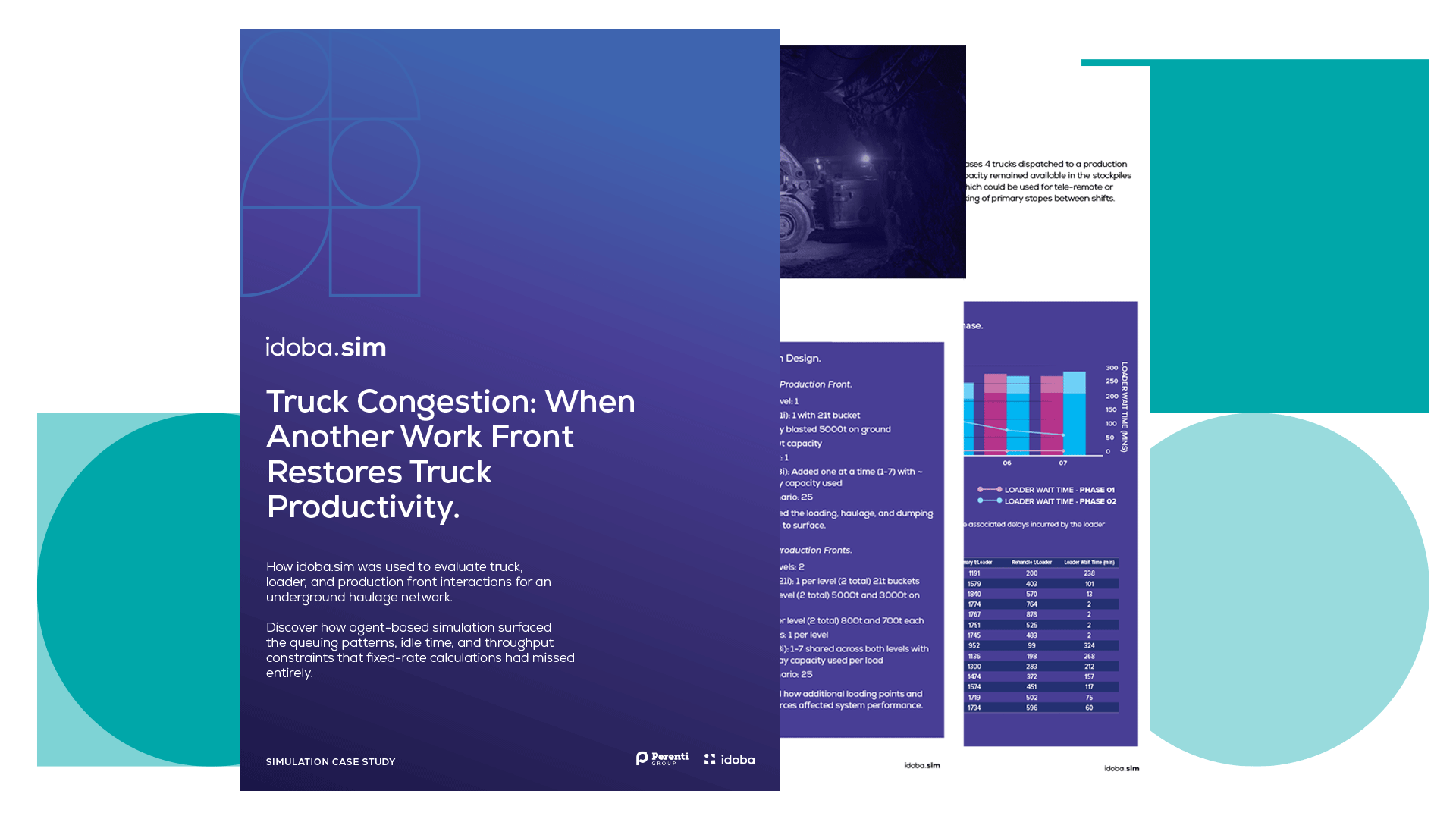
This simulation study shows how idoba.sim can be used to evaluate truck, loader, and production front interactions underground and how agent-based simulation can surface the queuing patterns, idle time, and throughput constraints that fixed-rate calculations often miss.
31%
Increased Ore to Surface.
26%
Improved Truck Productivity.
Don’t Just Take Our Word For It.
Award Winning Simulation Software.
Winner of the 2025 Mining Technology Excellence Awards for our innovative use of Agent-based modelling and user-friendly workflows that are transforming how mining short-term planning are done.
As Featured: Mining Magazine.
The Underground Reimagined: Transforming Material Movement into Strategic Capability.
An in-depth, annual exploration of the key trends shaping the future of underground mining.
Client Testimonial.
"With idoba.sim, I can quickly and easily stress-test schedules in a 3D digital representation of our mine with all the upcoming stope and heading locations to make sure our underground operational targets are achievable with our current fleet."
- Operations Specialist, Barminco.
As Featured: Mining Magazine.
From Adoption to Integration.
The Digital Underground Mining Report Explores how underground mining operations can align culture with new digital technologies.
SECTION 2
Navigating the Executive Challenges in Underground Mining.
Mining operations run on margins that leave little room for planning assumptions that don't hold. General Managers face pressure from every direction - safety targets, capital allocation decisions, production targets, and shareholders that expect certainty the operation is performing at its peak. The decisions that protect margin aren't made on the floor. They're made in the planning room, weeks before crews go underground. That's where the gap is. idoba.sim lets planning teams stress-test plans, equipment allocation, fleet sizing, before crews are committed, so critical decisions are made on evidence, not assumption.
Understand Fleet Utilisation Before You Commit.
Simulate fleet sizing scenarios and identify where equipment is sitting idle or generating congestion before it shows up as variance on the monthly report.
Compare the Weekly Plan Against Operational Reality.
Run multiple scenarios against your mine network and your fleet to understand the probability ranges before the schedule is locked.
Test Capital Decisions and Your Development Timeline.
When the Leadership teams asks whether the development timeline holds, show them a distribution of outcomes. Not a static average.
SIMULATION USE CASE
Using Agent-based Simulation to Reduce Vehicle Proximity Events.
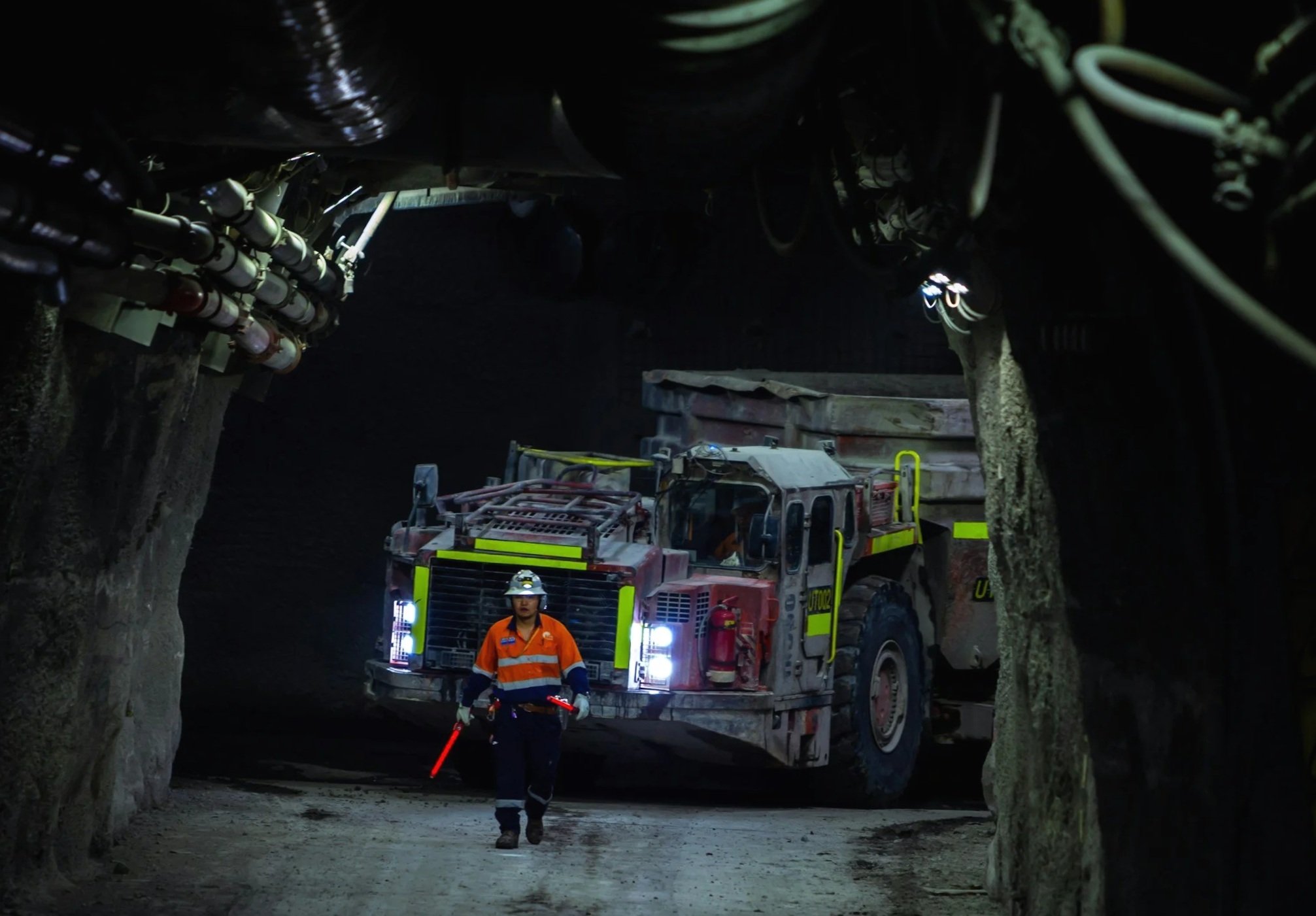
This simulation study highlights how the agent-based modelling capabilities of idoba.sim were used to address the critical challenge of congestion risks within a complex underground haulage network for an Australian gold producer.
Understanding how operational changes such as mine design, traffic rules, and driver experience played a key role in reducing vehicle interactions, improving safety and productivity.
The Development Advance Gap: Where Capital Quietly Leaks Underground.
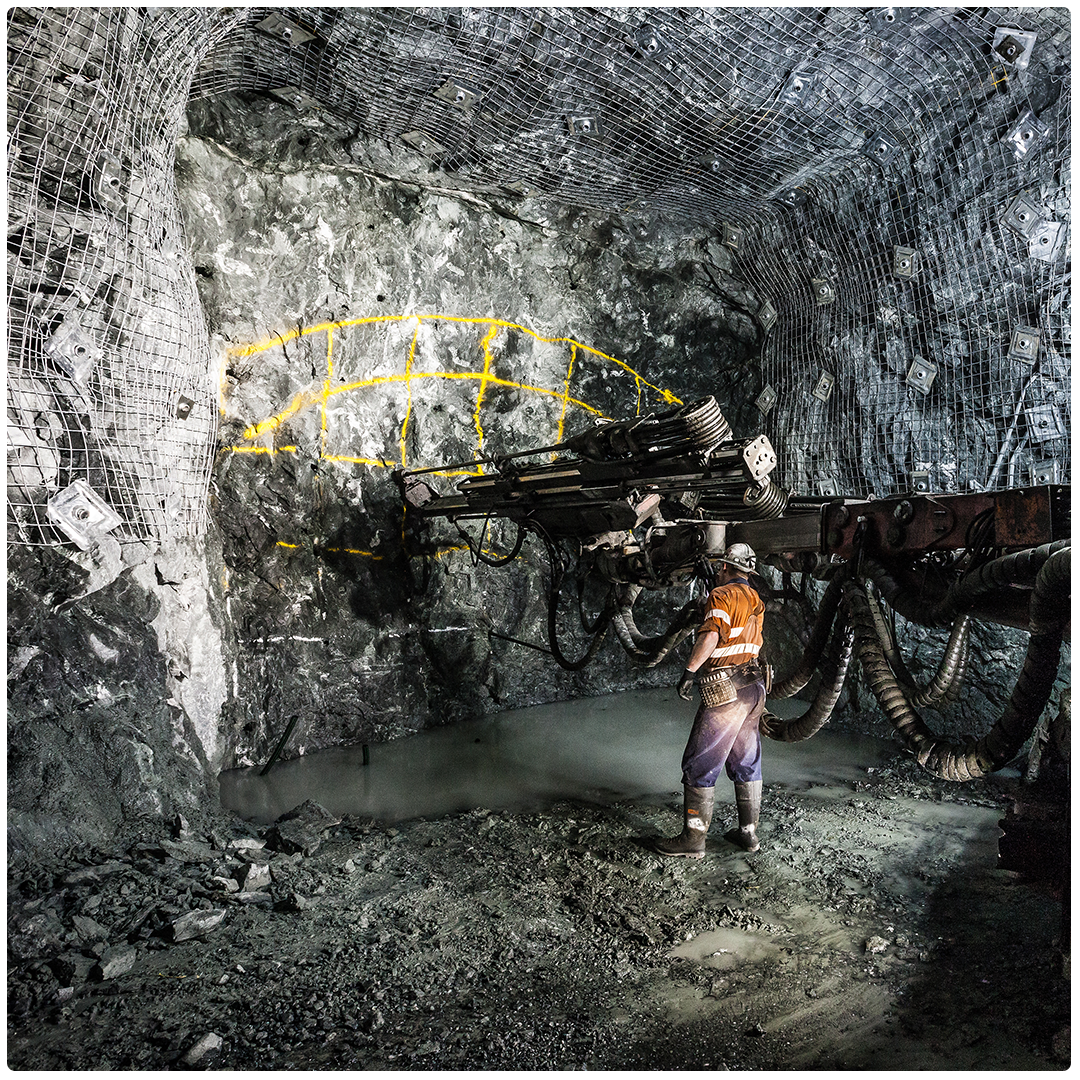
Every underground operation builds a development schedule. Very few can say with confidence that the schedule will translate to the achieved rate at the working face. The gap between what is planned and the actual advance is where NPV, ore access, and operational credibility quietly erode, shift by shift.
Most teams already know this. What they don't always agree on is how much confidence the schedule really holds before crews, equipment, and capital are committed to it.
SIMULATION USE CASE
Benefits of a Dedicated Stockpile.
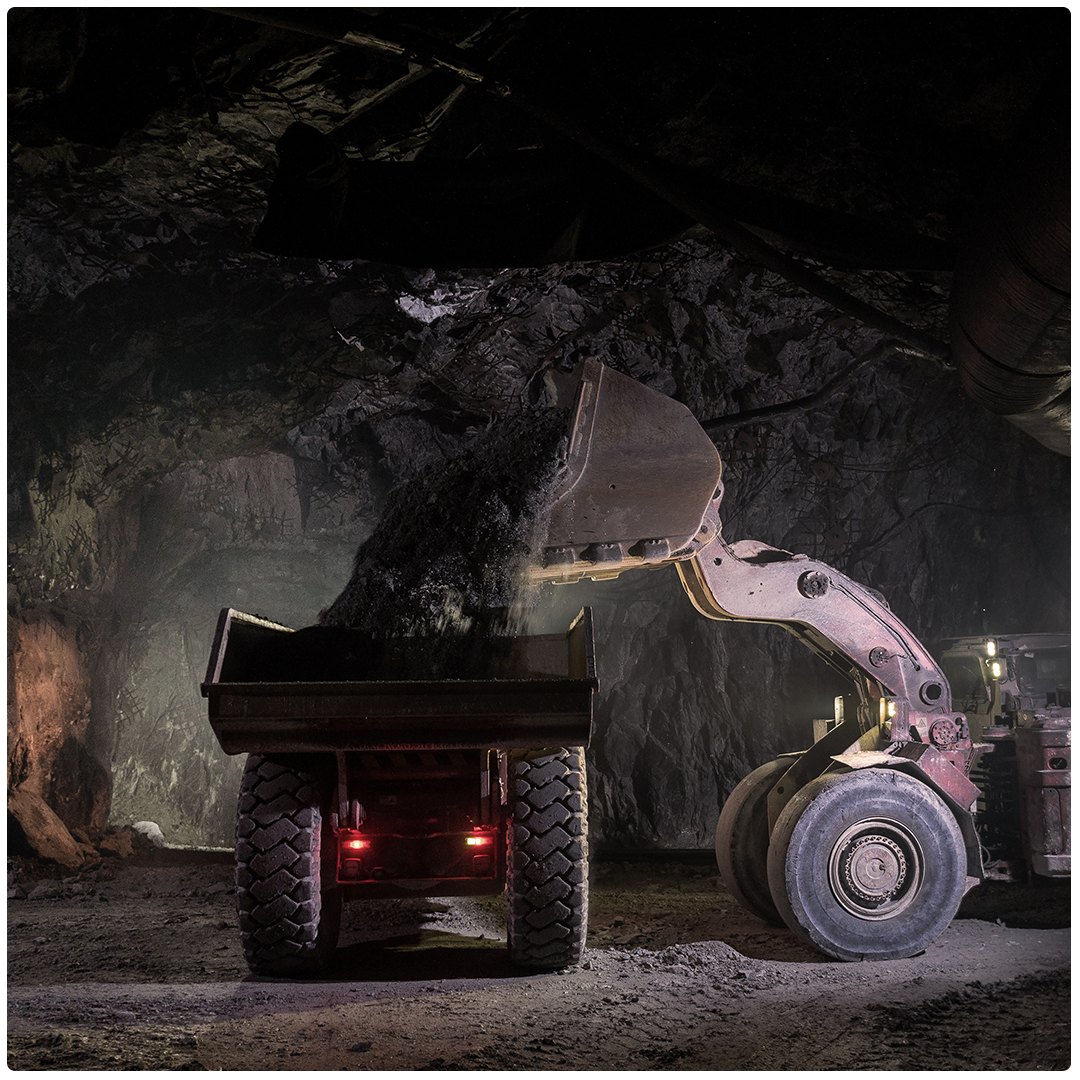
Adding a stockpile changes how every truck, loader, and shift sequence interacts underground. The question isn't whether a stockpile helps in theory and it's whether it helps enough in your mine.
A recent study used idoba.sim to model dedicated stockpile placement in an underground hard rock operation. The simulation examined total material moved, ore tonnes delivered to surface, truck productivity, and shift transition performance across the P10, P50, and P90 range. The planning team had the simulated data to make the capital case before a single tonne of ore was moved.
39%
Increased Loader Utilisation.
12%
Increase Ore to Surface.
SECTION 3
The Reality for Planning Engineers.
You built the schedule. You checked it against the fleet. You handed it to the crews. Then something changed underground, and the shift started unwinding before it started.
As a short-term planner in underground hard rock mining you carry the weight of every assumption in the plan. Ground conditions. Advance rates at each heading. Equipment availability. When those assumptions don't hold, the pressure lands on you to adjust the schedule in real time, with limited visibility, and crews waiting for guidance.
The problem is conventional scheduling tools model what happens when everything goes to plan, not the range of what actually happens. idoba.sim lets you stress-test the plan against your mine network, your fleet, your sequence and see the P10/P50/P90 range of outcomes across the 14-shift window before you commit.
Stress-test Your Schedules.
Run intra-shift scenarios against your actual mine network and fleet before the shift starts. Identify where the schedule is fragile before it becomes a problem on the decline.
Reduce Plan Drift.
When conditions change, re-run the scenario with updated parameters. Understand the range of outcomes under the new configuration — not just a revised average.
Understand What the Shift Delivers.
See cycle times, loader utilisation, truck interactions, and advance rates across the probability range. Hand the Supervisor a plan that reflects what the mine can do, not what it would do if everything went perfectly.
Make Operational Decisions. With Confidence.
See Where Throughput is lost, Before the Shift Starts.
idoba.sim builds a 3D model of your underground mine network and runs every truck, loader, and jumbo as an independent agent - making decisions, waiting, reacting to congestion, and competing for the same decline space your crews navigate every shift.
Identify bottlenecks and congestion hotspots.
See where haulage constraints emerge and evaluate equipment allocation.
Identify inefficiencies that traditional planning tools often overlook.

Adapt to Unexpected Events.
Underground conditions change. A ground support delay at one heading changes the sequence. An equipment breakdown reshuffles the entire shift. The schedule that looked solid at 6am can look very different by midday.
Stress-test shift schedules and refine production plans.
Re-run the revised scenario and confirm whether the updated schedule achieves the production target before crews are committed.

Reduce Operational Costs.
Simulation offers a cost-effective way to stress-test mine designs, fleet sizing, and sequencing decisions before capital is committed, not after.
Evaluate the impact of adding stockpiles, expanding fleets, or adjusting equipment allocations across the full P10/P50/P90 range.
Compare scenarios side by side against your actual mine network.
Arrive at the planning meeting with a probable distribution of outcomes in hand.

WHY IS IDOBA.SIM DIFFERENT
Agent-based Modelling. Not Fixed-rate Averages.
Conventional planning tools use fixed rates. idoba.sim runs differently. Every truck, loader, and jumbo operates as an independent agent with its own logic, constraints, and priorities. Loaders wait when the face isn't ready. Trucks queue when the decline is congested. Shift change effects ripple through the network the way they do underground.
Run 25 statistically varied simulations per scenario. The output is a P10/P50/P90 distribution, the realistic range of what your schedule can deliver. Not an average. A range your team can work with.
SECTION 4
Simulation Software Built for Underground Mining.
idoba.sim is built and backed by Perenti, with over 35 years of operational hard rock mining experience across Australian and global operations. The model reflects how underground mines behave, because it was built by people who ran them.
Cloud-based. No Complicated Infrastructure to Manage.
idoba.sim is cloud-delivered. Your team accesses it through a browser. No servers to provision, no software to install or maintain.
Built for Mine Planners and Schedulers.
If you can describe your fleet, your haulage network, and your weekly schedule, you can run a scenario. No simulation experience is required.
From Question to Answer in Hours, Not a Planning Cycle.
When your planning team uses idoba.sim the turnaround from question to answer is hours, not weeks waiting on an external engagement.
Frequently Asked Questions.
-
Yes, our expert team is ready to assist you right away. Your dedicated product specialist will conduct coaching sessions to help you establish your mine network, configure scenarios, and provide valuable feedback on your results, ensuring you maximises the full benefits of our idoba.sim.
-
Our user-friendly software is designed for fast deployment. You’ll gain immediate access to idoba.sim and be able to configure and run single-shift scenarios in minutes, with more complex multi-shift simulations taking longer depending on the scope and detail.
-
Yes, our advanced simulation software allows your planning team to efficiently set-up, execute, and compare multiple scenarios. This helps identify the most effective and economical methods for operating your underground mine, mitigating potential risks before significant investments are made.
-
Automated reports cover the metrics Planning teams need to validate the weekly schedules: development rates, truck cycle times, tonne-kilometres, loader utilisation, primary tonnes moved, and equipment idle time. Results are returned as a P10/P50/P90 distribution across 25 statistically varied runs, so you see a realistic range, rather than fixed-rates.
-
idoba.sim employs various modelling techniques, including Agent-based modelling to accurately simulate individual entities like jumbos, trucks, loaders, and spraymecs. This provides you with simulated data outputs and a greater understanding of potential operational outcomes.
-
idoba.sim is designed to be configured quickly. Our product experts will work with your team to prepare your mine network data, including centreline points and vertices, stopes and stockpiles. Then during our first training session we will work with you to configure traffic management rules, one-way actions, and speed limits, as well as any custom equipment information and you will be ready to run multiple scenarios, across the full production cycle for up to 14 shifts with idoba.sim.