The Development Advance Gap: Where Capital Quietly Leaks Underground.
Every underground operation builds a development plan. Very few can say with confidence that the plan will translate to the achieved rate at the working face. The gap between planned and actual advance is where NPV, ore access, and operational credibility quietly erode, shift by shift.
Most teams already know this. What they don't always agree with is how much confidence the plan really holds before crews, equipment, and capital are committed to it.
Why the Gap Matters More than it Used to.
Development is the critical path to almost everything downstream. Stoping sequences, backfill cycles, ventilation commissioning, production ramp-up, all of it is paced by how quickly the mine advances. Slippage on a single decline or ore drive doesn't stay local. It rolls through the plan and into the P&L.
The commercial cost of that variance is bigger than most boards discuss publicly. Research by EY found that as of 2023, one in five mining megaprojects (over USD 1 billion) were running over on cost or schedule, and the same analysis attributed the pattern to gaps in planning and project design rather than market or permitting issues.
On operating mines, the effect is less visible but no less costly. A quarter of schedule slippage against a revised development program is a quarter of delayed ore, deferred cash, and rework that the operations team carries long after the variance is explained.
More predictable development is one of the highest commercial levers in the mine plan.
What Static Mine Planning Tools Can't See.
Development advance plans are still built, overwhelmingly, on deterministic assumptions. A target rate of metres per month. An average cycle time. A fixed drill availability. A single best-estimate ground condition profile.
The face doesn't work on averages. It works on distributions, and those distributions are shaped by variables that don't behave linearly.
Ground conditions are the most obvious ones. Poor ground can halve advance rates overnight, and published benchmarks from hard-rock operations show the same crew and equipment moving from over 8 metres per day in competent rock to under 3 metres per day when conditions deteriorate. None of this is new to anyone who has run a development program. What simulation adds is the ability to stress-test how that variability flows through the plan: which headings get hit hardest, where the sequencing falls over, and what the cost looks like in lost metres and deferred ore.
Then there are the interactions that spreadsheets struggle to capture at all. A jumbo waiting for a bogger to clear a heading. A ground support crew stood up behind re-entry. Two headings compete for the same loader. Ventilation sequencing that blocks productive hours. Rework from an unexpected geotechnical call. Each of these, modelled individually, looks manageable. Stacked across a 14-shift window in a multi-heading operation, they reshape what the plan can deliver.
This is the distinction that matters. The plan isn't necessarily wrong. It's just optimistic in ways that are hard to see until the week runs.
What Simulation Actually Changes.
The question for a Technical Services Manager or Mine Manager isn't whether simulation is interesting. It's whether it changes the decisions that get made in the weekly plan meeting, or before the next capital submission. The honest answer is that it only matters if it does.
Underground mining simulation software, like idoba.sim earns its place by letting the team stress-test a development plan before it goes live. Agent-based modelling replicates the real interactions on the mine: equipment, crews, ground support cycles, shared access, ventilation constraints, competing priorities between development and production.
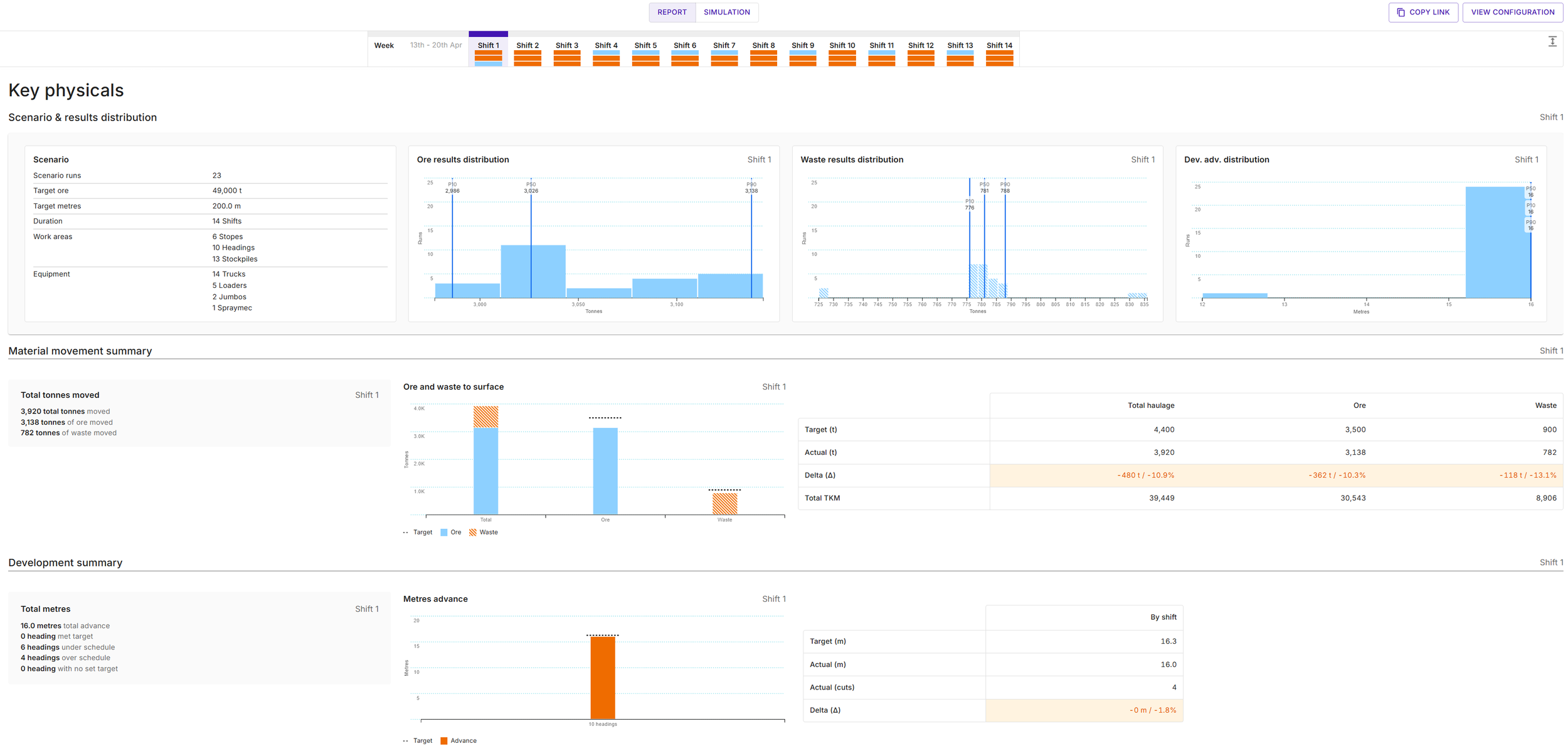
The Key Physicals dashboard in idoba.sim shows the performance of development activities across 14 shifts.
A 14-shift plan can be run through the model and stress-tested against scenarios the schedule was silent on. What happens if ground conditions deteriorate on the hanging wall drive? What happens if one jumbo is down for 72 hours? What's the real cost of re-sequencing two headings to protect a stoping start date?
The output isn't a better spreadsheet. It's a more honest picture of what the plan will deliver under realistic operating conditions, and where the quiet bottlenecks sit before they cost money.
That changes the quality of conversation with Operations. It changes the quality of the risk picture presented to the Executive team. And in feasibility or FEL context, it changes the defensibility of the development schedule underpinning the capital decision.
Why This Matters Now?
The operating environment isn't getting easier. Grades are declining. Depths are increasing. Development programs are longer, more complex, and more capital-intensive. Capital discipline across the sector has tightened, and the bar for defendable schedules in front of Boards and Investors has risen with it. At the same time, the depth of experienced planning talent in most operations is thinner than most General Managers would like to acknowledge publicly.
That combination means development plans are being asked to hold up under more scrutiny, with less margin for optimism, and with fewer senior hands to catch the errors before they become variances.
A More Honest Plan is Worth More than a More Ambitious One.
Development advance plan confidence isn't a reporting problem. It's a decision problem. And it can be solved before the first round is drilled, not after the first week of variance.
The operators beginning to close the gap aren't adding more assumptions or building more detailed spreadsheets. They're running their plans through a virtual version of the mine first, where a bad decision costs nothing to recover from, and surfacing the interactions, congestion, and sequencing risk that static scheduling quietly misses.
That's what simulation is for. Not a replacement for the planning stack. A way to make sure the plan sitting on top of it is one the operation can deliver.
idoba.sim is an operational simulation software used by underground operations to stress-test development and production plans before crews and capital are committed.
If you'd like to see what that looks like. Our team runs a 30-minute discovery call with Technical Services and Operations Leaders to walk through it. Schedule a meeting today.
Hear More From idoba.
Subscribe for practical insights on underground mining simulation. You'll receive new guides, case studies, and perspectives from the idoba.sim team on making data informed operational decisions.